August 12, 2026: The Rare Day Four Celestial Events Align
A planetary parade, a total solar eclipse, a new moon, and the Perseid meteor shower peak — all within one 24-hour window.
Skywatchers and stargazers alike, mark your calendars. The August 12 celestial events lineup is one of the rarest skywatching windows in recent memory — four major cosmic happenings stacked into a single day. Whether you follow the sky for its beauty or its meaning, this is a date to feel in your bones.
1. A Six-Planet Alignment Before Sunrise
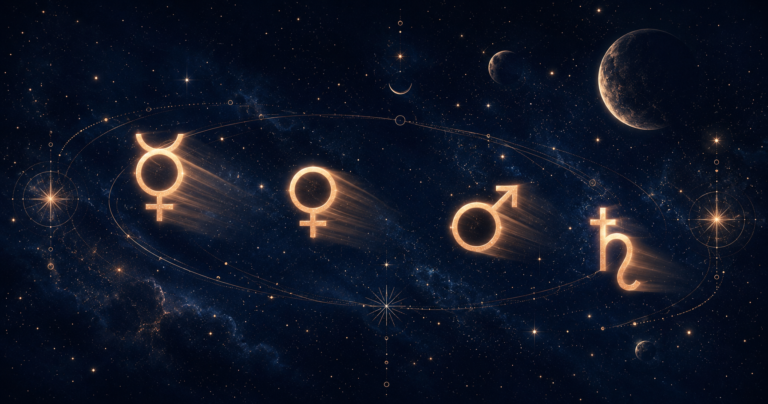
The day opens with a planetary parade. Jupiter, Mercury, Mars, Uranus, Saturn, and Neptune all line up across the pre-dawn eastern sky. Mars and Saturn are the easiest to spot with the naked eye. Meanwhile, Jupiter and Mercury follow close behind. Uranus, however, needs binoculars, and Neptune requires a telescope. If you’re on the U.S. East Coast, look up around 5:18–5:34 AM Eastern (9:18–9:34 AM UTC) for the best window — outside that zone, convert to your local time or use the calculator linked below.
Energetically: six planets sharing the same stretch of sky is a rare moment of cosmic alignment — a nudge to notice where your own life areas are (or aren’t) working in harmony.
2. A Total Solar Eclipse
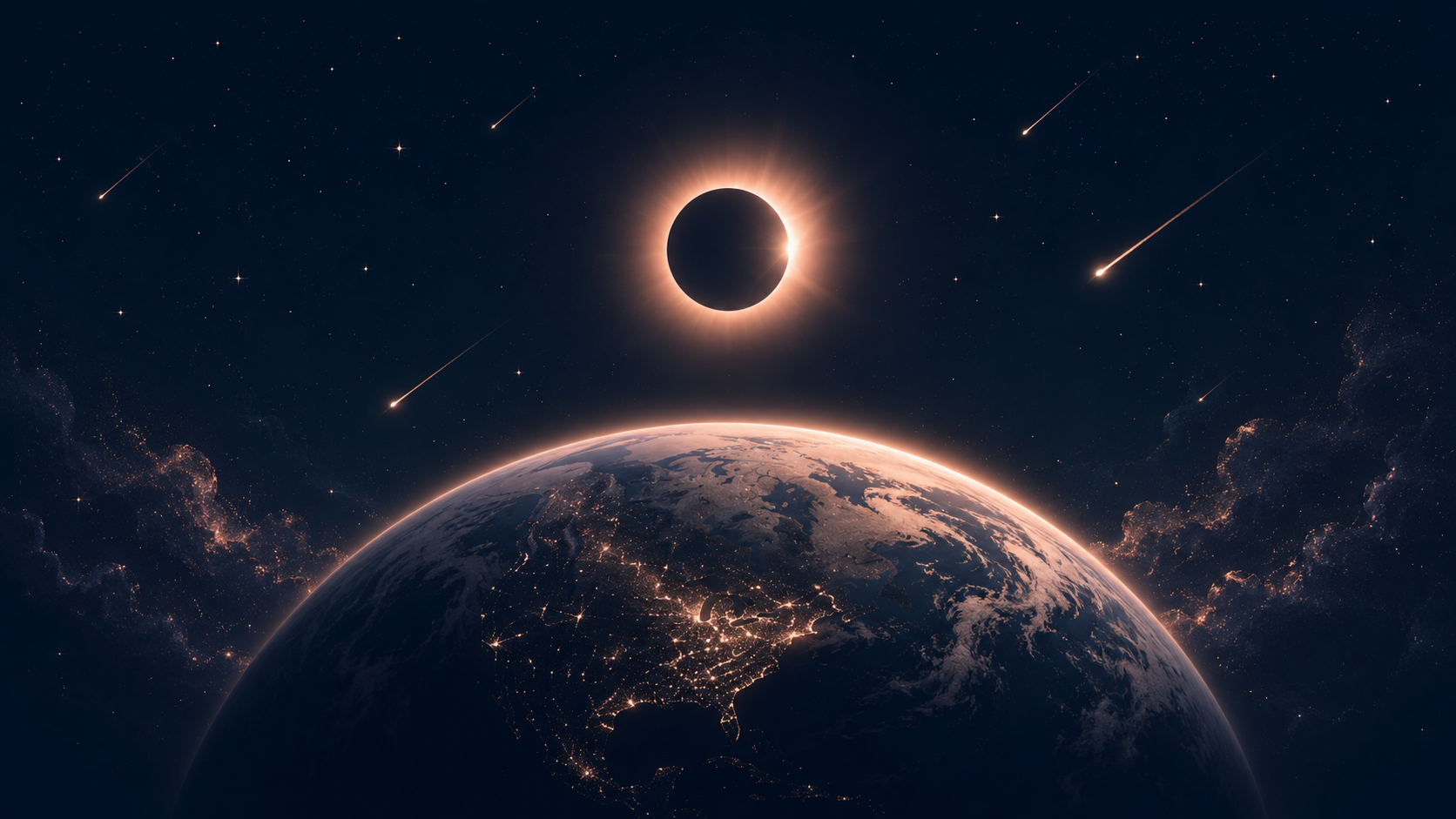
Later in the day, the Moon fully covers the Sun. The path of totality crosses northern Russia, Greenland, Iceland, and northern Spain, with a sliver of Portugal catching totality too. In the U.S., a partial eclipse will be visible from Alaska down through North Carolina. Exact start and peak times vary widely by location, so check the calculator linked below for your specific window. In fact, an estimated billion people fall under the Moon’s shadow in some form on this date. Still, never look at the sun without certified eclipse glasses, even during a partial phase.
Energetically: solar eclipses are traditionally read as accelerated new-moon energy — a portal for release and sudden new beginnings, amplified well beyond an ordinary lunation.
3. A New Moon
A total solar eclipse can only happen on a new moon, and this one lands at 1:37 PM Eastern (5:37 PM UTC). Every new moon is a natural checkpoint for setting intentions — this one carries extra weight, arriving fused with the eclipse above.
4. The Perseid Meteor Shower Peak
As night falls, the Perseids reach their peak — one of the most reliable and brightest meteor showers of the year. The shower continues into the early hours of August 13. Because the new moon leaves the sky completely dark, this is shaping up to be one of the best Perseid viewings in years. So, find a clear view away from city lights and give your eyes about 20 minutes to adjust.
A Numerology Note on 8/12
Reduce the date itself — 8 + 1 + 2 + 2 + 0 + 2 + 6 — and you land on a 3: the number of creativity, expression, and expansion. Paired with a sky this active, it’s a fitting undertone for a day built around new beginnings.
How to Watch the August 12 Celestial Events
- Pre-dawn (around 5:00–5:45 AM local): face east for the planetary parade
- Midday: eclipse glasses on if you’re in the visibility path — never watch unprotected
- After dark: find open sky, skip the flashlight, and let the Perseids do the rest
Curious what time these August 12 celestial events peak in your specific location? Use our free Planetary Hours Calculator to convert these windows to your local time zone.
For official viewing maps and safety guidance, NASA’s August skywatching guide is worth a look before the day arrives.