What is a Retrograde? Every Planet Explained
Mercury gets all the attention — but every planet goes through this. Here’s what each one means for you.
What is a retrograde? It’s when a planet appears to move backward through the sky from our point of view here on Earth. Every time Mercury enters this phase, social media erupts — but here’s something most people don’t know: Mercury isn’t the only planet that does this. Every planet in our solar system experiences it at some point, and each one carries its own unique energy and meaning.
What Does Retrograde Actually Mean?
The word comes from the Latin “retrogradus,” meaning “backward step.” When a planet enters this phase, it appears to move backward through the sky from our perspective here on Earth.
The key word is “appears.” Planets don’t actually reverse their orbit. What we’re seeing is an optical illusion created by the different speeds at which Earth and other planets travel around the sun. Imagine two cars on a highway — when a faster car overtakes a slower one, the slower car appears to move backward relative to the faster one. That’s essentially what’s happening here.
For a deeper scientific breakdown of how this optical illusion works, NASA has a great explainer on apparent planetary motion.
“This isn’t about things going wrong. It’s an invitation to slow down, review and realign — to look inward rather than outward.”
How Astrologers Interpret This Shift
In astrology, when a planet enters this backward phase, its energy is said to turn inward. Instead of expressing itself outwardly and moving forward, it asks us to revisit, reflect and reconsider. It’s a time of review rather than initiation.
Each planet rules different areas of life. So when this shift happens, the themes that planet governs tend to require more attention, patience and introspection. This is why these periods are often associated with delays, miscommunications or things feeling stuck — not because something is going wrong, but because we’re being asked to slow down in that area.
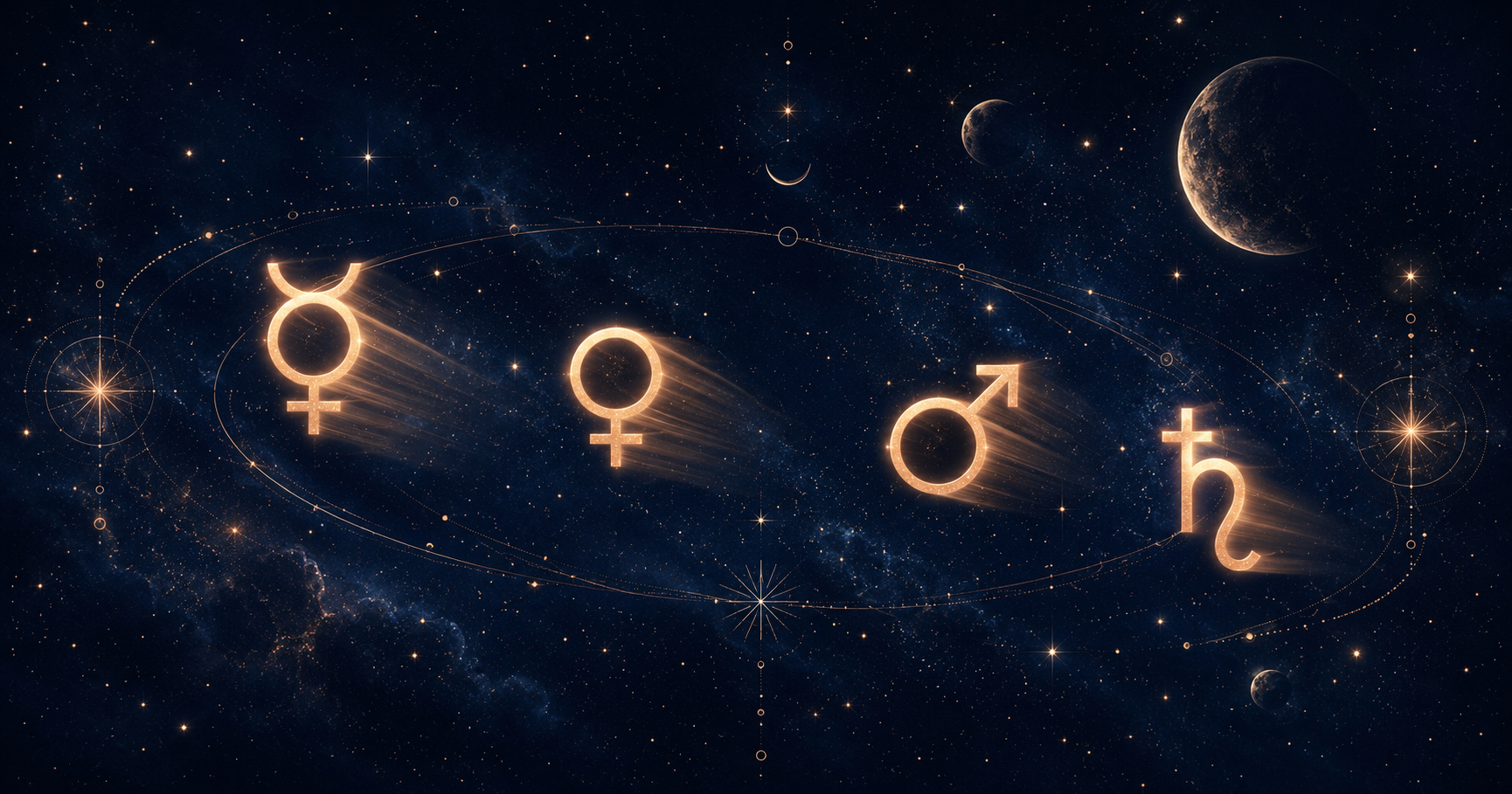
Every Planet’s Backward Journey
Rules communication, technology, travel and the mind. During this period, expect miscommunications, tech glitches and travel delays. Best time to review, revise and reconnect — not to sign contracts or launch new projects.
Rules love, beauty, relationships and values. Past lovers may resurface, relationship issues come to the surface, and our sense of self-worth is re-evaluated. Not ideal for new relationships or major beauty changes.
Rules action, drive, ambition and desire. Energy feels low, motivation stalls, and frustration can build. Best used for reassessing goals and redirecting energy rather than pushing forward aggressively.
Rules expansion, abundance, wisdom and growth. Growth turns inward — a time for inner wisdom, philosophical reflection, and reassessing where you’re expanding in ways that no longer serve you.
Rules discipline, structure, karma and responsibility. Old karmic lessons resurface and we’re asked to re-examine the structures in our lives — work, boundaries, long-term commitments. A powerful time for inner accountability.
Rules innovation, rebellion, sudden change and awakening. The urge for radical change turns inward — a quieter, more internal revolution that questions where you’re not living authentically.
Rules dreams, spirituality, illusion and intuition. The veil between reality and illusion lifts. Things that were foggy become clearer, spiritual practices deepen, and creative inspiration flows inward.
Rules transformation, power, death and rebirth. Deep psychological transformation is invited — hidden truths surface, power dynamics shift inward, and old wounds ask to be healed rather than suppressed.
Outer Planets vs. Inner Planets
You may notice that the outer planets — Jupiter, Saturn, Uranus, Neptune and Pluto — experience this every single year for several months at a time. Because of this, their effects tend to feel less dramatic on a personal level and more like background energy that shapes collective themes over time.
The inner planets — Mercury, Venus and Mars — go through it less frequently and for shorter stretches, which is why their effects tend to feel more immediate and personal. Mercury gets so much attention because it happens several times a year and touches the things we depend on daily: communication and technology.
How to Work With This Energy
The biggest mistake people make is treating these periods as something to fear or survive. This energy is not punishment — it’s an invitation. Here’s a simple way to think about it:
The prefix “re” is your best friend during this time. Review. Reflect. Revisit. Reassess. Reconnect. Restore. These periods are not the time to launch, push forward or start something brand new — they’re the time to look back, tie up loose ends, and go inward.
When you work with this energy instead of against it, these stretches become some of the most productive and insightful times of the year — even if they feel slower on the surface.
Every planet experiences this shift — not just Mercury. Each period asks us to slow down and turn our attention inward in the specific area of life that planet governs. Rather than dreading it, use these stretches as built-in cosmic checkpoints to reflect, review and realign.
Want to see how this plays out in real time? Check the 2026 Retrograde Calendar for exact dates, or read the full breakdown of Mercury Retrograde Storm Dates.
Curious what your birth chart reveals about how you handle this energy?
Discover Your Moon Sign